18 Jul 2026
Cora Silka was born beneath the glittering towers of a city that never spared a glance for the people living in its shadow.
The great city of Muerdas Ocala was renowned for its lantern festivals, sandstone promenades, and caravans heavy with foreign luxuries. Beyond its walls, however, sprawled a maze of leaning tenements, flooded alleys, crowded markets, and makeshift homes where hunger was more dependable than kindness. Cora grew up there among dockworkers, beggars, smugglers, and children who learned early that innocence was a luxury.
She never knew her father, and her memories of her mother were scattered: the scent of cheap floral soap, tired hands combing knots from her hair, and a voice warning her never to trust anyone wearing polished shoes. By the time Cora was old enough to understand poverty, she was already living alone.
She survived by becoming whatever people needed her to be.
To a baker, she was a starving orphan with enormous, pleading eyes. To a merchant, she was a distracted customer asking endless questions while one hand slipped beneath the counter. To city guards, she was frightened, apologetic, and hopelessly lost. Cora was quick-fingered, quicker-witted, and possessed of an effortless charm that made suspicion feel almost impolite.
Her magic emerged quietly. Shadows seemed to gather around her when she wished to disappear, while her voice carried a subtle warmth that encouraged people to underestimate her. Although her Nightwalker heritage gave her an instinctive connection to darkness, Cora never delighted in fear or cruelty. Darkness was shelter, not a weapon. She preferred an open smile, an elegant bow, and a carefully chosen lie over threats or bloodshed.
She stole because she had to.
At least, that was what she told herself.
The Circadian Circus
When Cora was thirteen, the Circadian Circus arrived in Muerdas Ocala.
It came at twilight.
Its wagons were painted in midnight blues, sunrise golds, and deep, shifting purples. Lanterns floated above the procession without chains, illuminating dancers who spun through the streets while musicians played from the rooftops of moving carriages. Acrobats hung from ribbons of enchanted silk, masked performers breathed silver flame, and mothlike faeries scattered luminous dust over crowds that had forgotten how to be unhappy.
At the head of it all walked Aureven Glasswing, the circus’s ringmaster.
Aureven was magnificent then. Tall, poised, and impossibly handsome, he possessed translucent wings that shimmered like stained glass held before the sun. His voice could silence a crowd without effort, and every gesture seemed choreographed for an audience. He was charming, theatrical, vain, and utterly aware of the effect he had on others.
Cora had never seen so much beauty gathered in one place.
Naturally, she attempted to rob it.
She slipped beneath the circus wagons after midnight, intending to take only enough food and coin to last a few weeks. She made it farther than anyone expected, bypassing locks, performers, and even the circus’s trained creatures. She had nearly reached Aureven’s private carriage when his hand closed around her wrist.
The ringmaster was less impressed by her talent than enraged by her audacity. Whether he intended to turn her over to the city guard or make an example of her, Cora never discovered.
A second voice interrupted him.
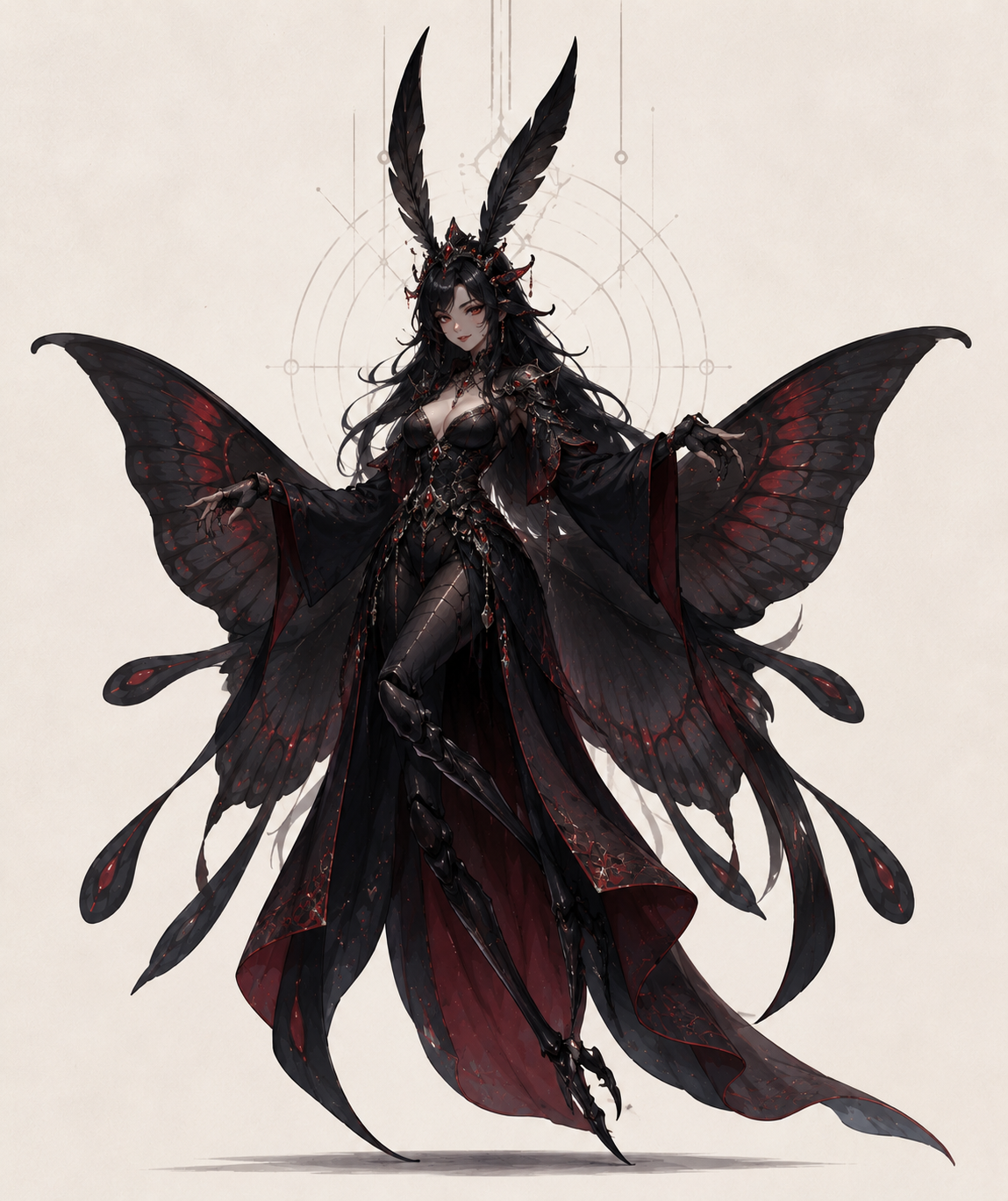
Lavender Nightmoth, the circus’s celebrated aerialist, stepped from the darkness.
Lavender was everything Aureven was not. Her beauty was warm rather than commanding, her smile unguarded, and her enormous blue wings seemed to hold the quiet colours of the night sky. She looked at Cora not as a thief or nuisance, but as a frightened child who had learned to bare her teeth before anyone could strike her.
Lavender convinced Aureven that anyone capable of entering his supposedly secure caravan unseen was too talented to waste.
Cora was offered a choice: leave with nothing, or work for what she had attempted to steal.
She chose the circus.
That choice became the beginning of her life.
A Home Beneath the Bigtop
At first, Cora performed the least glamorous work imaginable. She swept sawdust, fed animals, polished buckles, patched costumes, and crawled beneath wagons to retrieve dropped tools. She complained constantly and secretly loved every moment of it.
Thw Circadian Circus became the first place that ever made room for her.
The acrobats taught her balance and how to fall without breaking. The knife throwers taught her precision and the importance of appearing calm while terrified. Escape artists showed her locks, knots, concealed compartments, and the value of letting an audience believe they understood the trick. Actors taught her accents, posture, disguise, and how to become someone else without losing herself completely.
Lavender became Cora’s closest companion and, in many ways, the elder sister she had never possessed. She helped Cora read difficult passages, corrected her table manners without humiliating her, and remained beside her during the nights when old memories made sleep impossible.
Aureven’s affection was harder earned.
He demanded perfection and treated the circus as an extension of himself. Yet he recognized Cora’s potential. He taught her how to control a room, how to build anticipation, and how to understand what an audience wanted before they understood it themselves. His praise was rare, but Cora treasured it.
In time, she developed an act of her own.
Cora performed as the Lady Nocturne, appearing from impossible places to steal rings, handkerchiefs, and watches from audience members before returning every item in a cascade of black silk and glittering moth dust. She danced between suspended blades, escaped locked glass boxes, and invited volunteers onstage only to reveal secrets they had unknowingly surrendered through nervous gestures and careless words.
She was elegant, playful, and magnetic.
For the first time, Cora was not merely surviving.
She was happy.
Old Habits
Yet the circus could not entirely erase the girl Muerdas Ocala had created.
After performances, Cora often slipped away from the caravan and visited local taverns. There, dressed in fine clothes and carrying herself like a woman of means, she sought out wealthy patrons eager for attention.
She listened to merchants boast about their fortunes, officers complain about their superiors, and noblemen describe adventures they had likely paid others to undertake. Cora laughed at dull jokes, offered flattering observations, and let lonely men believe they had fascinated her.
By the time she departed, a purse, signet ring, or jeweled pin often departed with her.
She justified these thefts easily. The men were rich. The circus was always in need. She never took enough to ruin anyone. Sometimes she even gave the money to struggling performers or children living near the places they visited.
Lavender suspected the truth and warned her.
“You are not that hungry child anymore,” she told Cora. “One day you will steal from someone who values pride more than mercy.”
Cora promised to stop.
She meant it when she said it.
But promises made beneath warm lanterns were easily forgotten in dark taverns.
The Night the Circus Burned
The man Cora chose that night seemed no different from the others.
He was wealthy, well-dressed, and eager to speak of himself. He wore an ornate ring and carried a purse heavy enough to feed the circus for weeks. Cora entertained him for hours before excusing herself with a soft kiss to his cheek.
Only when she slipped through the tavern door did she realize the purse was not merely heavy with coin.
It contained documents, keys, and a sealed token whose importance she did not understand.
The man followed her.
Perhaps he wanted the contents returned. Perhaps he feared what she might discover. Perhaps humiliation alone was enough to drive him into a rage. Whatever his reason, he traced her through the alleys and found the Circadian Circus sleeping beneath the stars.
He did not call the guards.
He set fire to the bigtop.
Flame raced across the enchanted canvas faster than ordinary fire should have moved. Burning ropes collapsed. Wagons ignited. Terrified animals broke loose as performers stumbled from their beds into choking smoke.
Cora awoke to screams.
She helped pull two children from a costume wagon and cut an acrobat free from a burning support line. She searched desperately for Lavender, shouting her name until smoke stripped the strength from her voice.
Lavender never answered.
By dawn, the Circadian Circus was gone.
Many performers died. Others were maimed. Several simply disappeared in the confusion. Lavender Nightmoth was not among the living or the dead.
Aureven emerged from the ruins barely recognizable.
His once-beautiful wings had burned down to twisted frames. Much of his hair was gone, and the fire had scarred his face, chest, and limbs. The man who had commanded crowds with a smile could barely stand before them.
When he learned why the attacker had followed Cora, grief became fury.
Aureven declared that she had destroyed everything they had built. He swore that wherever she went, whatever life she tried to make, he would ensure she understood what it meant to have beauty, family, and purpose taken from her.
The surviving performers followed his judgment.
Some cursed Cora. Others could not bear to look at her. Even those who knew she had not lit the fire believed her recklessness had brought it to them.
She was forbidden from approaching what remained of the circus.
Cora left before sunrise, carrying nothing except a scorched performance cloak and one small blue ornament that had once hung from Lavender’s costume.
Sil Akaiah
Cora fled to Sil Akaiah, hoping a city large enough might swallow her completely.
For a time, it nearly did.
She returned to begging, stealing food, sleeping in abandoned rooms, and disappearing whenever anyone showed too much interest in her. Her stage confidence became a street performer’s smile. Her graceful tricks became distractions for pickpocketing. Every time she smelled smoke, she was back beneath the collapsing bigtop.
She stopped calling herself the Velvet Shadow.
She avoided circuses.
She told herself Lavender was dead because death was easier to endure than the possibility that Lavender had survived and chosen never to find her.
Then a noble stranger approached Cora in a crowded market.
Cora assumed she had finally been caught. She prepared three lies, two escape routes, and a hidden blade before the stranger finished introducing himself.
She said she represented House Gyrosic.
The House had been watching her. They knew she could enter guarded places, hear things people never intended to reveal, and pass unnoticed between the wealthy and desperate. More importantly, they believed she could recognize the difference between a truth and a convincing performance.
They offered her work as an informant.
Unofficially, of course.
She had drawn the attention of the Lady Ambryys.
Rather than treating her as disposable, Lady Ambryys trusted her with a matter of genuine importance: locating leads connected to a specific and dangerous artifact, the Heart of the First Flame. She did not ask Cora to become someone better. She simply gave her an opportunity to prove that her talents could build something instead of destroying it.
Cora clung to that faith fiercely.
She would not fail Lady Ambryys.
She would not lose another home.
And she would never again allow someone else to burn for her mistakes.
The Woman She Is Now
Cora remains charming, theatrical, and difficult to dislike. She prefers misdirection to violence and grace to intimidation. Even in darkness, she carries herself as though standing beneath the lights of the bigtop.
Yet much of her confidence is performance.
She keeps emotional distance through flirtation, jokes, and carefully controlled vulnerability. She is quick to comfort others but deeply uncomfortable when anyone tries to comfort her. When people call her good, she assumes they have not yet learned enough about her.
Cora still steals occasionally, though she insists it is now only for practical reasons. She targets the arrogant, cruel, and excessively wealthy, avoiding those who might truly suffer from the loss. Every theft, however, carries the memory of flame.
She keeps Lavender’s blue ornament hidden inside her clothing.
She has never removed it.
Read entry