






Polyhedral Dice
Some folks'll say you have enough dice. Those people aren't entirely incorrect, but I choose to ignore them anyway.
You can't have too many dice.
No....I need ALL the dice.Polyhedral dice are an essential part of most modern day tabletop roleplaying games. Typically, they are sold as a 6-8 piece set of multiple, differing plastic polyhedrons in brightly-coloured and aesthetically pleasing matched sets, with numbers on the faces. However, they can be made of a variety of materials. In recent years, small producers have created dice sets with resin casting, allowing internal decorations within the dice themselves, such as models of small animals, Glitter, and flowers or other nature features. A minority of dice creators also sell them in precious or semi-precious stone versions, or even metal casting. They can also be carved out of wood or soapstone, but this is rarely seen.
History
Ancient polyhedral dice date back over 2,000 years. These were often used for divination, fortune-telling, and games.
The oldest known 20 sided die dates to 2nd century BCE Egypt. It is carved from ivory, and it features ancient Greek letters on each face. Currently, it is located in Metropolitan Museum of Art.
The oldest known dodecahedron (12 sided die) dates to the Roman era (around 50 CE), likely originating in Greece and crafted from rock crystal.
Ancient tetrahedral dice (4 sided)—along with other gaming pieces—were used in the Royal Game of Ur in Mesopotamia as early as 2500 CE.
After falling out of use for centuries, non-cubical dice were independently re-invented and mass-produced in the 20th century.
Japanese inventor Yasushi Ishida created an icosahedron (d20) numbered 0-9 twice for use in education and statistics in 1950.
In 1963, Fredda Sieve patented the first multi-dice game containing all five Platonic solids (d4, d6, d8, d12, d20) for her game, Zazz Polyspheres.
Most familiarly to Literomancers, in 1974, Gary Gygax and Dave Arneson published Dungeons & Dragons, which relied on polyhedral dice for resolving complex probabilities. Early printings required players to order the dice from educational supply companies or colour in number-stamped shapes manually until TSR packaged them in 1977.
Significance
In addition to being necessary to participate in most tabletop roleplaying games, which is a popular hobby in the 21st century, polyhedral dice — known colliquially as "(shiny) math rocks," often serve additional functions for Literomancers. They are an important component in creating the stories that fuel the Literomancy that many RPG gamer literomancers use as a focus for their magic, in which they help to randomize decisions made at points of tension, and physical combat for the characters.
However, literomancers use them in other ways as well. Some have rediscovered their ancient usage as a focus for divination. Technomancers and other technically-oriented literomancers also use them as an aid in complex statistics, as Yasushi Ishida intended.
Many literomancers who have never joined a Dungeons & Dragons game also use them to introduce randomized chance elements into their plots, or as components or foci in their spells and enchantments.
It is not uncommon for literomancers to assign different values to the faces of polyhedral dice as well — such as astrological signs on the faces of a d12 — or to use those numbers to represent other things.
The Secret Order of The Iron Tome used a d12 to determine which of them would guard the Tome on their randomized schedule.
The Iron Crowns of the Woodlanders included, not just crowns, but three sets of polyhedral dice that were given to House Sauropoda by the Woodlanders.
Some hobbyists, as well as literomancers, collect dice for their artistic or commemorative value.
WIP
Streamer
Missing
Status: Location Unknown
Deceased
Status: Deceased Character
Retired
Status: Retired Character or Article




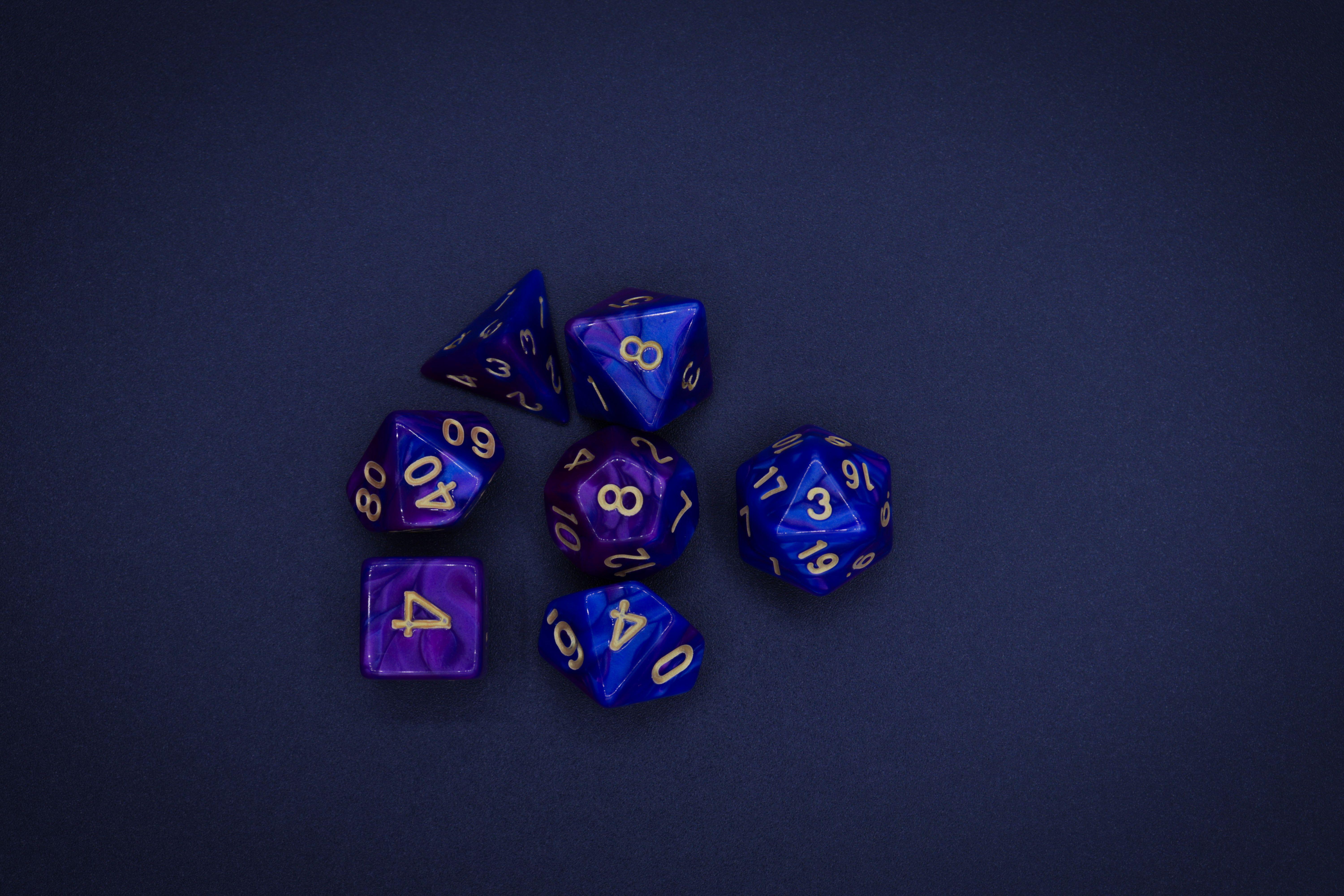
Polyhedral dice by Pic Panther (Pixabay)
Item type
Toy
Related ethnicities
Rarity
Common
Weight
Varies, usually no more than a few ounces/grams
Base Price
Approximately $10-$15 USD in their typical plastic set form, but price can vary broadly with producers, materials, and complexity of production
Raw materials & Components
Typically, polyhedral dice are cast from plastic or resin, occasionally of metal. Stone and gem dice must be tooled or carved into shape, unless shaped by a Geomancer.
Tools
Numbers are generally inset into the faces of the dice, and must be clearly legible. Usually, they are also marked with a contrasting colour to be visible, most commonly with paint or enamel, but sometimes with inlay or gold or silver leaf.
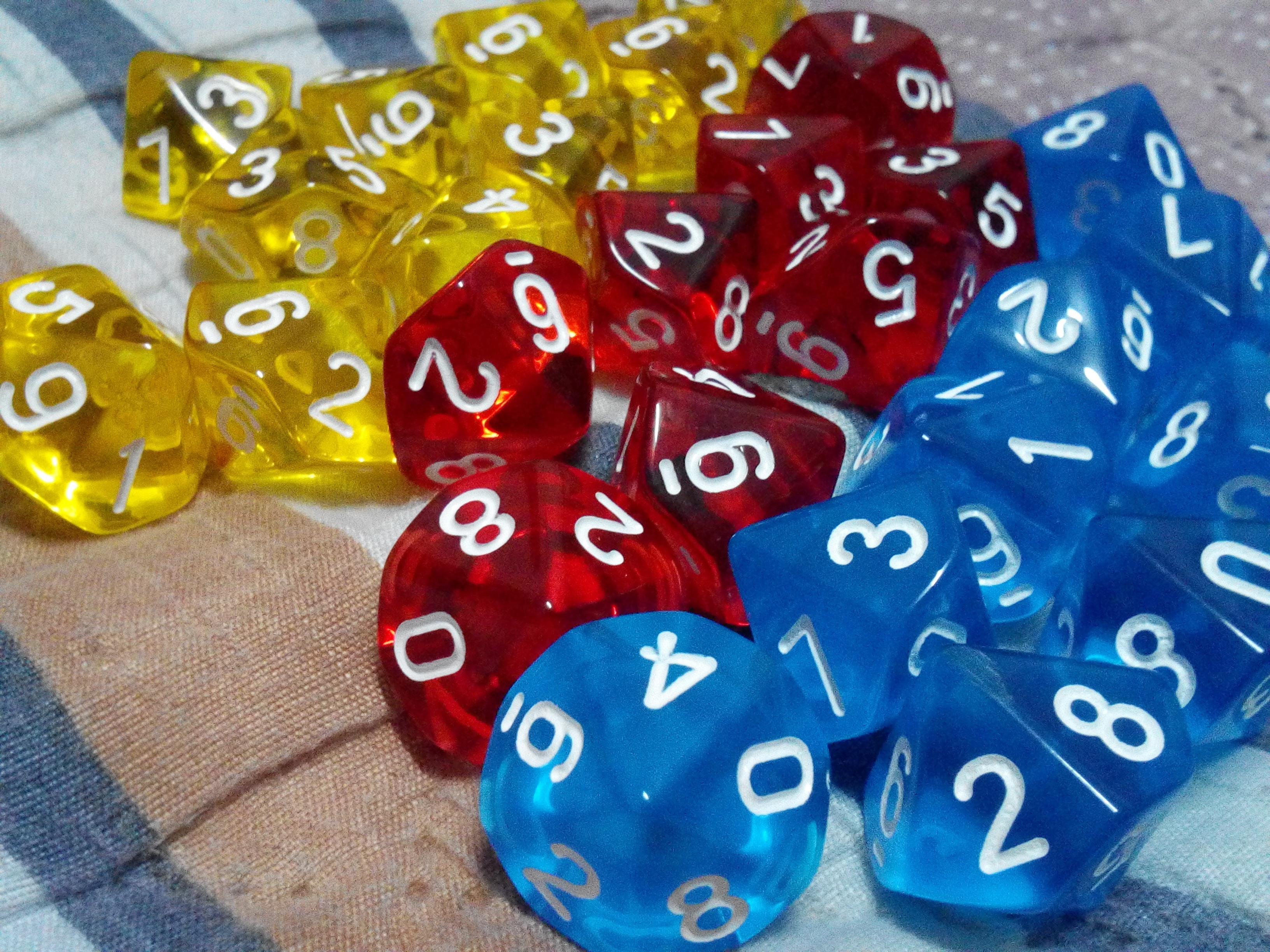
Three sets of polyhedral dice by Jaonun (Pixabay)



Comments