What troubles can't be solved with a cup of tea, gentle words, and a calm mind?
It was
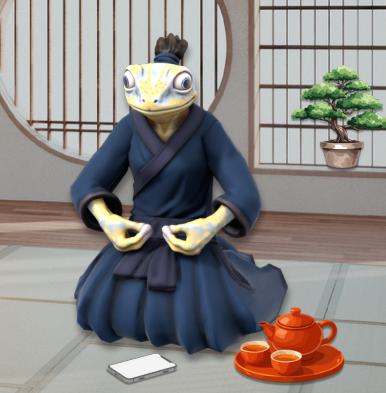
Kimotsuki Yorimoto who brought Theamancy to the
Tomeverse when he traced his wife
Princess ShyRedFox here via the necklace he gave her, which had a pinch of her favorite tea inside the gem.
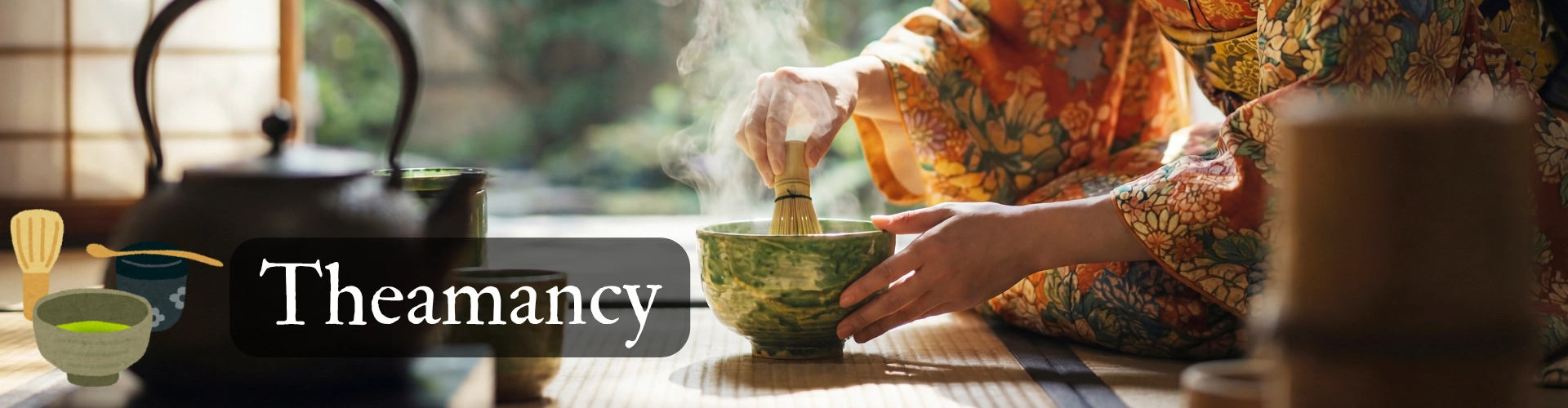
Theamancy is
Literomancy based on
chadō, the Japanese way of tea. To Yori (a samurai who left the way of the warrior behind after the Battle for Shikoku in 1585), tea is about healing and gentle affirmation. (This doesn't mean Yori won't fight. He just prefers to focus on life and the restorative arts now.)
Yori feels this domain of magic should not be confined to one
House. He will teach at least the beginner level spells to any Literomancer. He'll observe his students to see if he feels comfortable enough with letting them learn more advanced techniques. (He wants to be sure the spirit of use for healing, harmony, and goodness he intends will be honored.)
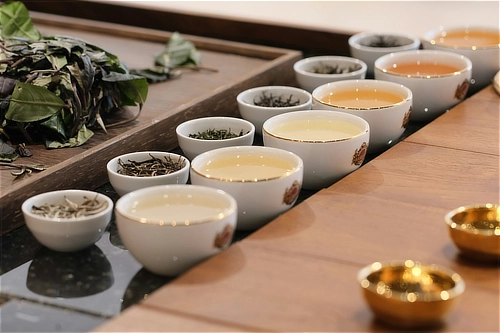
When one partakes in a cup of tea, it is never merely drinking tea. It is an experience. No two cups, nor the drinking of them, are ever exactly the same.
Manifestation
The magic of tea is often quiet and unobtrusive. It's not fancy. Rather, it's humble and you may not notice it's effects until you have time to reflect afterward on the experience.
It's the magic of deliberate choices, reflection, observation, listening, and the principles of the tea ceremony. Yori says a darker side of this magic is possible. But he does not teach it, since it contradicts his mission and he feels it pollutes tea magic. Thus, they aren't listed.
If you do notice an immediate manifestation, it will be subtle, almost like a ninja lurking in the corner. Effects include: a soft glow that fades quickly, improved mood or mental state, a zen like state. Colors range from a yellow orange to a matcha green.
Theamantic Principles
Theamancy is based more on principles than on laws, unlike other literomantic domains such as
Geomancy or
Vivimancy.
Ichi go, ichi e. (一期一会)
one time, one meeting, the sense that each instance is truly once in a lifetime (pronounced "ee chee go, ee chee eh)
Wa (和)
harmony, peace, and balance in a group
(pronounced like "wah" as in "WAnder")
Kei (敬)
respect
(pronounced like "kay" as in "CAme")
Sei (清)
purity
(pronounced like "say")
Jaku (寂)
tranquility through practicing wa, kei, and sei
(pronounced like "jya koo" as in "JOhn" and "raCOON")
Ma (間)
emptiness, space (giving emphasis on what few things are intentionally put into the area)
(pronounced like "mah" as in "MAntra")
The path
awareness of a person's oneness in nature and that the path may choose you as much as you choose it
Mastery through repetition
It goes beyond just "practice makes perfect". There is first learning to follow the principles, then learning where they can be bent, then transcending them to be able to create on your own and be recognized for it.
Mathematics and strategy
disciplines which should be studied if at all possible
Areas and Types
Literomancy Levels
Minimum level needed is listed before the ability/spell. Variations are listed below.
| Symbol | Level + Description |
|---|
| | Beginner: Anyone may learn this ability.
Similar to a cantrip or low level spell. |
| | Advanced : Achieved after study and practice.
If the mage is from outside the originating House or group of this magic type, they need to train under a Master of this magic school from the originating House or group. (If the power is shared between Literomantic schools, the Literomancer trains under one of the appropriate House's/Group's Masters for that area.)
In other words, please talk with the House or group that is known for that type of magic. |
| | Master: Achieved after considerable study and practice, usually after tutelage under a Master.
A Master may be a member of another House or group. |
| | Reserved: Epic level aspect, reserved ability.
This is usually reserved for an individual player, House, or group. |
Theamancy Sharing Key
Minimum level needed is listed before the ability/spell. Variations are listed below.
This domain's spells are shared with or related to the following domains and the relation is noted next to each spell. Exceptions are also noted. See "Known Variants in Other Houses" for details of the relationship between the spells.
Zen and the State of Being
Calm Mind
while meditating or performing the tea ceremony you may calm and/or clear your mind
may cause this effect for 1-2 others (the effect is offered, not automatically enacted upon others)
may cause this effect for a crowd of up to 30 people (the effect is offered, not automatically enacted upon others)
(Some crossover with Artisimancy, Aquamancy, Versomancy, and Vivimancy.)
Reading the Room
you may see into the heart and mind of another (This is not mind reading, but reading reactions, wishes, and intentions as in the Japanese expression "to read the room".)
the practitioner may do this for up to 10 beings at once
the practitioner may do this for up to 50 beings at once
Where this spell can go wrong: Assumptions and negative emotions (like arrogance or inferiority) can skew the reading and lead to misunderstandings. This spell should be used with humility and care.
(Some crossover with Versomancy, and Vivimancy.)
Gift of Presence
just being near another gives them a sense of comfort, safety, and security, bringing down levels of anxiety, fear, and other negative emotions
the practitioner is able to help calm an extremely distraught being
the practitioner is able to calm up to 5 extremely distraught beings at once
the practitioner is able to calm a crowd of up to 100 beings
Where this spell can go wrong: The caster must be aware that their presence is welcome. If it is not, the intended effect will not manifest.
(Some crossover with Artisimancy, Aquamancy, Versomancy, and Vivimancy.)
Mischievous Delights
minor animated effects, such as small firework-like lights appearing from no where, or an origami figure or a tea treat moving as if it were alive. (Note the effects will not work if intended to do harm.)
The caster may cause the effect on a large (up to 10 feet/3 meters tall) non-living subject or up to 10 small (up to hand sized) non-living subjects at once.
The caster may cause the effect on a huge (building sized) non-living subject, 5 large non-living subjects, or up to 100 small ones.
(Some crossover with Artisimancy.)
Highest Grade
using the best quality tea that one can afford (or other spell ingredients/non-living subjects) acts as a boost effect for the spell increasing it's efficacy.
Note: The effect is meant to be subtle and minor, like in the taste differences between the highest grades of teas.
For example: it may boost the Reading the Leaves spell to 2 words or Mischievous Delights spell to 2 items affected for beginner spells.
(Some crossover with Artisimancy and Technomancy.)
Kotodama
The spoken or written word brings the idea into existence as a object or an effect on an object. An advanced Theamancer my bring a small (hand-sized object) into existence or apply an effect on an object up to a large size. The process is expensive Literomantically, and can't be done more than once a day without risking Magic Drain.
Similar to summoning, but for objects and they aren't called from another place. Instead, the object or effect is formed from atoms and Literomantic Energy in the location of the spell. Also similar to wards, as an effect can be put on an object.
(This spell comes from the Japanese idea that words and names contain power and that speaking can affect the world around oneself. Thus their tendency to not speak negatively if possible. Yori says this power can't affect other beings because it's too intrusive to apply to anything living.)
A master may bring a large (human-sized) object into existence or they may cause an effect on something of huge (building size). It immediately causes mild magic drain and requires recovery time.
It is not recommended to bring an object of a greater than large size into existence because of the drain on the available Literomantic energy and atomic material in the area. It may also kill the caster.
(This is much more generalized than related aspects in other domains, thus its range or effect is limited. ** Please reference "Known Variants in Other Houses" for the details and the list of domain connections, as there are many.)
Those who cannot feel the littleness of great things in themselves are apt to overlook the greatness of little things in others. — Okakura Kakuzo, The Book of Tea (1906).
The Path
Reading the Leaves
A single word message from a being, living or dead is read from the tea leaves at the bottom of a tea cup. The message is intended for the requester, not the caster. It is often used for advice or a chance to say goodbye or a last important message. (One must have a calm empty mind for this.)
Note on consent: The person running the character contacted for the short message must give approval for this to happen. If they do not, the spell simply fails and the tea leaves say nothing. If the message is to be from the dead, the GoT GM will need to give permission for former PCs if the person running the character isn't available. (Remember GoT runs on a system of consent.)
Note on the message: The caster is simply a conduit for the message. Only the requestor understands/interprets the meaning. (Ironically, this may or may not be what the interpretation the one contacted to send the message intended.)
A short message (a simple sentence of 7 words or less) may be divined.
The caster may be the requestor. (Advanced level is required due to needing to step back from any emotion in asking or receiving the answer.)
A longer message (a paragraph of up to 5 sentences and a maximum of 100 words) may be divined.
(Some crossover with Artisimancy and Aeromancy.)
There Is No Spoon
Allows the caster to overcome a problem with the realization that it didn't actually exist in the first place or that the problem could be solved by turning it on its ear. This may take the caster up to a day.
A master may solve the problem in a matter of minutes.
Tea Ceremony
able to bring a sense of harmony, peace, and tranquility to the attendees (up to 10)
Requirement: must study under a tea master as a student and be granted permission to conduct the ceremony on one's own
Able to teach the way of the Tea Ceremony
(Some crossover with Aquamancy and Vivimancy.)
Empty room
This spell relies on the concept of Ma (emptiness). It allows the caster to hide by transferring the caster to the pocket dimension of tea for up to 5 minutes. After the allotted time is up, the caster is returned to where they left and they appear to fade into existence.
The caster may bring up to 5 willing beings with them for up to half and hour.
The caster may bring up to 20 willing beings with them for up to a day.
(Some crossover with Inanemancy and Technomancy.)
Transformation of the path
One follows the path (usually to the tea house) but diverts to another space temporarily. This involves using a Laplacian transform, thus bending the rules of the path so you can solve the problem of where you need to go by focusing on something from where you are going. Then you change the rules back to the original path and complete the journey. The ability to see where one should do the transform is rare.
Yori found his way to the Tomeverse via tea magic, the tea in Shy's pendant, and his love for his wife using this method. It was extremely taxing and he's hesitant to use it ever again. Shy hasn't been able to get more than a few scattered details from him. He will not teach this spell because there's a great risk of it going wrong.
(Some crossover with Inanemancy and Technomancy.)
(Reserved for Yori)
Domain Notes
(from HRH Princess Shyredfox and Kimotsuki Yorimoto creators of the Theamancy lore)
The list of Theamancy spells is intentionally shorter than other domains. It represents the spells Yori chose to bring into the Tomeverse. Over time, additional spells may be added, but the list will be kept limited to keep the unique aspect of tea magic.
In Japan, I took part in a tea ceremony... a banal daily event is transformed into a moment of communion with the universe. — Okakura Kakuzo
Known Variants In Other Houses
Aeromancy
Messenger and Paper Airplane Message
Reading the leaves is similar, but may be used to transmit a message from the dead. Messages are likely more restricted than that in those used by Aeromancers.
Aquamancy
Still Waters
Similar to Calm Mind and Gift of Presence, but the Theamancy version is meant to be a soothing aspect.
Scurry Communication
Reading the leaves has a similar effect, but may be used to transmit a message from the dead and it's communicated aloud by the spell caster/conduit. Messages are likely more restricted than that in those used by Aquamancers
Artisimancy
Buff/Debuff
Calm Mind and Gift of Presence are like mood buff spells. And Highest Grade is like a minor spell buff.
Paper Airplane Message
Reading the leaves is similar, but may be used to transmit a message from the dead. Messages are likely more restricted than that in those used by Artisimancers
Animation
Mischievous Delights is a specific minor example of the Artisimancy spell.
Inanemancy
Tang Portal and Void Rift
Empty room and Transformation of the path are both portal spells but with specific purposes and a different method.
Technomancy
Portal
Empty room and Transformation of the path are both portal spells but with specific purposes and a different method.
Versomancy
Group Chat Energy and No Words Left
While there is no visual manifestation of a person's mood, Reading the Room allows the caster a similar peek into another being.
Pillow Fort Protocol, The Cooldown, and Borrowed Calm
Similar to Calm Mind and Gift of Presence
Vivimancy
Whisperer
Instead of an animal, in Theamancy the subject is a sapient being. Related tea magic spells are Calm Mind, Reading the room and Gift of Presence.
Heartweave
Similar to Reading the Room, but it is a spell done on purpose.
** Too many spell relations to separate out
Kotodama
This Theamancy spell is more generic (and thus more limited) than similar spells the following domains. Since it's only mildly related to the domains below, it's not listed in their Known Variants.
Versomancy (Smokescreen, Cloud of Darkness, The Flinch, etc)
Aeromancy (SFX, Distorted Whispers, Arrow's Flight, etc.)
Aquamancy (Conjure Water, Rainmaker, Ice Weapon and Ice Shield, etc.)
Artisimancy (Buff/Debuff, Animation, Manifestation, Memory Box, etc.)
Geomancy (Luminosity, Summon Earth Elemental, Animate Fossils, Stone Ward, etc.)
Inanemancy (Eldritch Speech, Summon Void Elemental, Conjurations, etc.)
Vivimancy (Lifeweaving)
Ordermancy (Kotodama shared with this domain)
But first, tea. — Yori









Comments