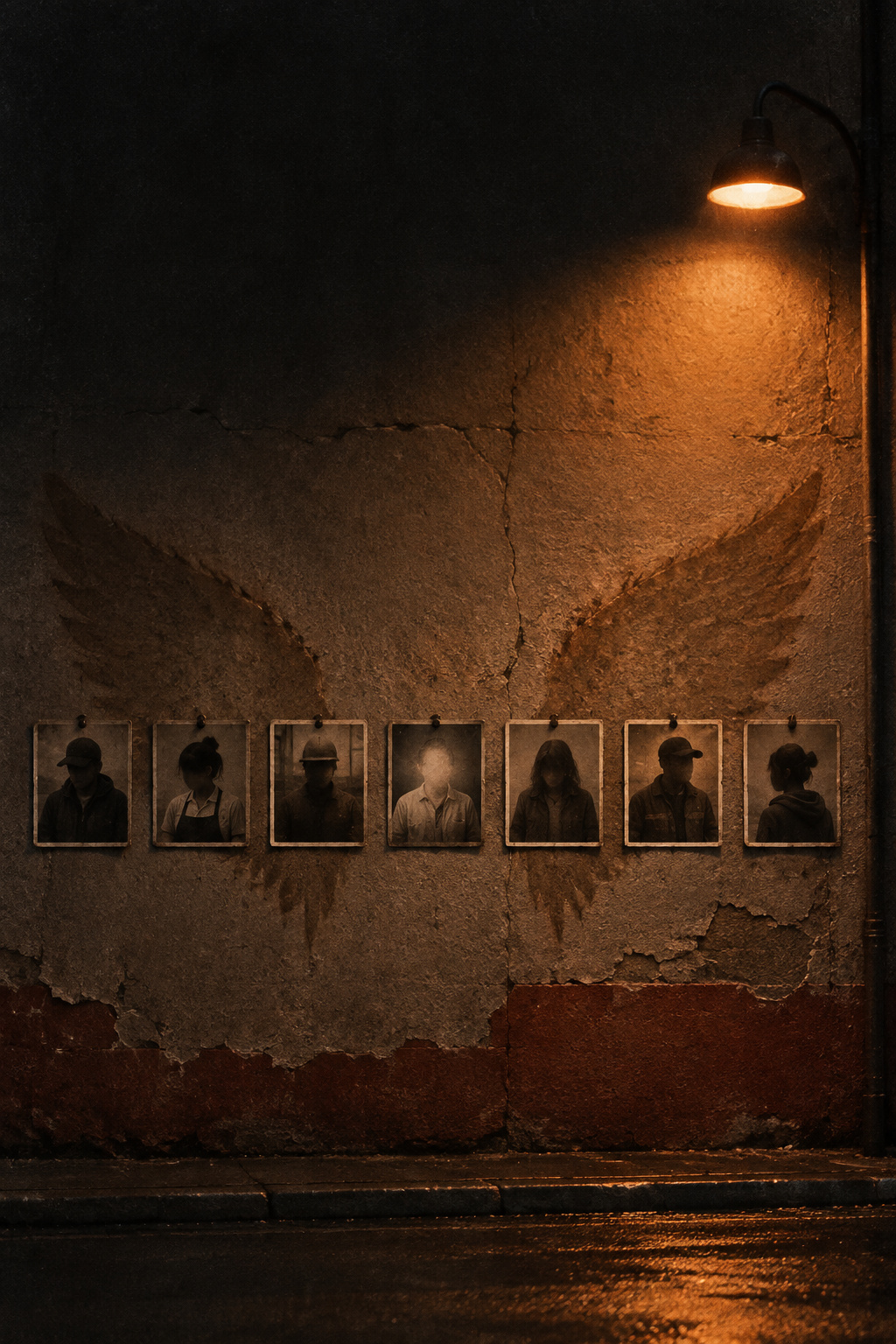

The air conditioner in room nine dripped into a plastic tub that had once held noodle salad, and the sound was the first thing Vanessa Quintero heard when she woke up a little after noon. It had been dripping like that since June, and Mrs. Oduya at the front desk had promised to send someone.
She lay there for a while with the sheet pulled up to her waist, looking at the ceiling. The room at the Blue Yucca Motel was small, and she had made it hers. On the dresser stood a ring light on a stand, a circle of white light the size of a steering wheel, and next to it a row of bottles and jars arranged by size. Her suitcase lay open on the floor with the clothes folded into compartments. On the wall over the bed hung a picture of a sunset over a desert, screwed to the wall so nobody would take it. She had draped a silk scarf over it.
She got up and sat down at the dresser in her underwear to do her makeup, even though it was Sunday and nobody would see her until evening. Doing it pleased her. The light made her face smooth and white, and she worked slowly, primer first and then foundation in two shades that she mixed on the back of her hand, until everything was even and the circles under her eyes no longer showed. She put the lashes on with tweezers, one strip at a time. When she was done she leaned back and turned her face to the left and to the right, as you do in a fitting room, and saw a woman who could have been twenty-five. She was thirty-one.
She had left Pomona at nineteen. A man with a camera had taken pictures of her in a garage in Montclair, with a white sheet hung up behind her, and told her she had a face the camera liked. Nobody had ever said anything like that to her before. Nothing came of the pictures, but she had learned one thing from them: a face is something you put on, and you can have a new one for every person who looks at you. The man with the camera was named Dale and sold insurance on weekdays, and she hadn't thought about him in years.
On her left upper arm, just below where the sleeve of her top would end, was the bruise from Saturday. It had gone yellow and green and was shaped like four fingers and a thumb. She put concealer on that too, knowing it would rub off on the fabric, and settled on the short black jacket even though it was in the nineties outside.
Before she left she paid for the week at the front desk. Mrs. Oduya sat behind the glass with her reading glasses on a cord around her neck, and on a small TV beside her a church service was playing at low volume, a preacher in a white suit in front of a choir in purple robes. Mrs. Oduya counted the bills twice and wrote out a receipt by hand.
"Still dripping in nine?"
"Every second."
"I called."
They both knew what that meant. Mrs. Oduya slid the receipt under the glass and didn't look up from the TV until Vanessa had turned to go.
"Nice jacket."
"Thanks."
Thuy had her salon in a strip mall on Sierra, between a laundromat and a place that sold phone cases, and had done Vanessa's nails every Sunday for six years. Thuy knew what Vanessa did for a living and had never said anything about it that sounded like a judgment. Mostly they talked about Thuy's daughter, who was starting at UC Irvine in the fall and wanted to be a pharmacist, and about Thuy's husband, whose back hurt and who wouldn't go to the doctor, and about the shows they both watched.
"The usual?"
Vanessa looked at the row of bottles on the shelf. She always took the dark red called Kiss & Tell Me More. Every Sunday she joked that she wanted it for the name, and every time Thuy laughed as if she had never heard it before.
"The usual."
Thuy worked with her head bent and a lamp pointed at Vanessa's hands. She filed and polished and blew lightly on each nail when it was done. Thuy was the only person who touched her every week without wanting anything, and Vanessa looked at the back of her neck, where her hair was starting to go gray at the roots.
Her phone buzzed in her purse while Thuy was working on her left hand. Vanessa fished it out with her thumb and forefinger, the other nails spread wide, and saw a number she didn't recognize. She answered anyway, in the voice she used for clients, a little lower and a little slower than her own.
The man on the other end didn't give his name. He said he'd gotten the number from a friend and asked if it was true that she saw clients in Fontana. She did. He asked what she charged for an hour and what was included, and when she had told him he explained what he was interested in, at length, in words he seemed to have practiced before he called. It was nothing she hadn't heard before. She listened to the end and said three hundred. When he hesitated she said it again in the same tone, and he said yes.
"Tuesday. Nine."
She gave him the address of the motel, but not the room number, and told him to text from the parking lot. Then she hung up and typed T – Tue 9pm – new into her calendar with her pinky, because it was the only nail that was dry.
Thuy hadn't looked up during the whole call. She went on polishing the ring finger at the same pace as before.
"New?" she asked.
"New."
"What kind?"
Vanessa didn't have to think about it.
"Married. Bank, or something with a tie. He's got what he's going to say written down, and he'll apologize twice before he even sits down." She blew on her pinky. "He wants somebody to think he's a good guy who's just had bad luck. So first I'm a little shy, and then I'm impressed with him."
"And then?"
"Then he asks what my real name is."
Thuy laughed so hard the brush slipped, and she wiped a streak of polish off the cuticle with her thumb.
"And what do you tell him?"
"Something that sounds real."
Thuy's daughter had gotten a scholarship. Thuy showed her the picture on her phone, a girl in a UC Irvine sweatshirt in front of a brick building, and Vanessa said she was beautiful, which she was, and that she had Thuy's eyes, which she didn't. Thuy was pleased. When it was time to pay, Vanessa slipped an extra twenty under the bottle of polish remover, where Thuy wouldn't see it until she was gone.
Out in the parking lot she held her hands up to the sun and turned them, and a woman carrying laundry out of the laundromat nodded at the nails.
At the bus stop on Sierra a man in work clothes sat waiting, and when she walked by he looked up. She gave him the face without thinking about it, the small smile and the look that lingered, and he sat up straighter. Farther on she felt tired all over, as if she'd worked a shift, and the bus came and went without her looking to see whether he got on.
The text from Brandon came while she was on her way back along Foothill.
Saturday at C's again. Wear the black one.
She knew which one he meant. The black dress was short and thin and made her visible from the other side of the barn. Brandon thought it was good that she was visible. The men standing around the pit bet more when there was something to look at while they waited, and Curtis Haney paid Brandon a cut for bringing her. That was how it had been since the spring. Brandon called it a favor he was doing her, because Haney's friends had money.
She remembered last Saturday by its sounds more than its pictures. She had stood against the wall of the barn with a can of beer in her hand that she hadn't drunk from. It had smelled of dust and motor oil and something sharp, like iron. The men had shouted, some in English and some in Spanish, and behind their shouting there had been another sound that she had stopped hearing sometime in the middle of the night, because she didn't want to hear it anymore. Afterward two of Haney's guys had carried something out the back door in a tarp, and she had seen the tarp move once on the way out, and then not again.
Haney himself hadn't looked at her once the whole night, and it was rare for a man in the same room not to. He looked at the dogs and at the money, and at the cooler by the table where he kept it under a row of beer cans.
When she had wanted to leave early, Brandon had taken her by the upper arm. He hadn't said anything. He had just held on, with four fingers and a thumb, until she stopped pulling.
She answered the text with ok and dropped the phone back in her purse.
Brandon had been in her life for two years. He had started out as a man who paid and become a man who arranged things, and he said he protected her, which in his way he did, the way you protect a car you own. He took a third.
Randy at the bar in Rialto had told her about a journalist named Brian who paid cash to listen. That was on Friday. Randy had been drying glasses behind the bar, and he'd added that Brian was one of the few in that line of work who did what he said he would. Vanessa had laughed at that, that somebody paid to listen, and after that she hadn't been able to stop thinking about it. When she came out of Thuy's, Brian had texted her himself: Brian here. Cholla Diner on Foothill, 8:30? My treat. She had answered ok with her nails still a little tacky.
In her room she changed twice. The black was for Brandon and Haney's barn, and the red was for other things. In the end she put on a pair of jeans and a white blouse she had bought for a job interview four years ago and never worn. She wanted to look like someone they write about in the paper, and she put the short black jacket on over it.
She was ten minutes late to the Cholla Diner. First she had stood outside looking at herself in the dark window next to the door, to see how she would look to him, and then once more because she wasn't happy with the braid.
He was sitting in a booth at the back with his back to the wall. There was gray in his stubble, and he was tired around the eyes in a way that had nothing to do with sleep, and there was a dried yellow stain down his shirt that he hadn't noticed. In front of him were a half-eaten sandwich and a cup of coffee. He looked up when she came in, and she waited for what always came, the quick look down her body and back up to her face. It didn't come. He looked at her face and her hands, and at the door behind her, as if he wanted to see whether anyone had followed her.
"You're Brian."
"You're Vanessa. Sit down. I ordered for both of us, I hope that's okay."
"Depends what you ordered."
"Pie. And coffee."
She sat down across from him and put her hands on the table so he would see the nails. He put his phone between them. The screen had a crack running in diagonally from the corner.
"I'm recording. Is that okay?"
"Randy said you pay."
"I pay."
Vanessa tried to read him, the way she read every man. It usually took her a few seconds. She could see what they wanted in how they sat, in their hands, and in what they did with their eyes when she leaned forward, and then she knew which face to wear for the rest of the evening. With Brian she got nothing. He sat and waited and chewed his sandwich, and the silence lay between them like a tablecloth he had no intention of touching.
"Tell it like I've never seen a dog," he said.
She had meant to give him a little, the kind of thing anybody could know, that it was Saturdays and that it was in Bloomington. Randy had said she could tell as much or as little as she wanted. But Brian listened in a way she wasn't used to, with his whole face turned toward her while his pen moved across the pad. When she finished a sentence he waited for the next one, and when she said anything important he wrote it down twice, once on the pad and once with his eyes. So she told him about Brandon and what his name was, and about the men at the pit, which ones bet the most and what they drove. After that came the cooler and the tarp, and last of all the black dress and why she had to wear it.
He ate while she talked, first the sandwich and then his own pie, without looking at the plate, and she thought that he ate the way other men smoke, to give their hands something to do while their heads work.
He asked for dates, and she gave him dates. When he asked which side of the barn the back door was on, she reached for a napkin to draw it, and her jacket sleeve slid up. He saw the bruise, and she saw him see it. She pulled the sleeve down and finished the drawing, and he said nothing about it. She was so grateful that she gave him the name of the Haney guy who usually carried out the tarps, though he hadn't asked for it.
The pie sat untouched in front of her. It was cherry, and the whipped cream had had time to melt down over the edge.
After half an hour she leaned back in the booth and looked at him.
"Nobody's asked me anything in five years that wasn't about price."
He didn't answer. He looked at her, and it wasn't the look she knew, the one that measured and added up. Whatever he was adding up, she didn't recognize it, and it made her face warm under the makeup.
"You can use it," she said. "All of it. You can say it was me."
"I protect my sources."
"I see what you're doing."
She smiled. She knew he was writing that down too, and she wanted him to.
When she stood up he put an envelope on the table. It was thicker than she had expected.
"This is for your time," he said, "not for what you say."
She put it in her jacket without opening it. It was the first time in a long while that she didn't want to know how much was in it.
The evening was as warm as the day when she came out, and Foothill lay wide and nearly empty under the streetlights. She walked west toward the motel, past the tire shop with its gates closed and a used car lot where the cars stood in rows under pennants that didn't move. Her heels clicked on the sidewalk, and she walked more slowly than usual, because she wasn't in a hurry to get anywhere and because she was carrying something in her jacket that could break if she ran.
She thought about his hands, which hadn't touched her, and about how he had asked which side of the barn the door was on, as if it mattered, and how she had known the answer. She thought about what it would look like in print. There was no telling which paper it would be, or if there would be one at all, but she could see the words in front of her in black and white, her own words, and someone reading them at a kitchen table and stopping on them.
The church sat back from the street, behind a parking lot. She had walked past it before without thinking about what it was, a low building with a beige front and tall windows, which had looked like a store once and still did. The parking lot was empty. The lights on the poles were on, and the light lay in yellow circles on the asphalt with darkness in between. Over the entrance a sign glowed in white letters, GLEANING FIELD FELLOWSHIP, and under it, smaller, Pastor Daniel Toomey. Behind the glass doors it was black.
Vanessa stopped at the edge of the first circle of light.
The last time she had been in a church was Christmas Eve Mass in Pomona, when she was fifteen and her grandmother was still alive. What she remembered was the candles and the smell of wax, and how good it felt to sit still in a room where nobody was looking at you, because everybody was looking toward the front.
A car went by behind her on Foothill, and when its headlights swept across the front of the building, a paler shadow of other letters showed under the beige paint, something long that had once been there and been painted over.
She read the name on the sign one more time. Then she pulled her jacket tighter around her, though it wasn't cold, and walked on.