




Aquatic Centaur
Aquatic Centaurs were an ancient, migratory marine people whose civilization spanned the northern seas for millennia. They were guardians of currents, builders of coral cities, and masters of tide-bound magic. They were wiped out during The Third Word War. Very little remains of their existence: fragmented military logs, shattered myth-archives, and Lady Wynter. She is the only known remnant of a species that once shaped the oceans’ hidden history. Their legacy persists in drowned ruins, oral traditions of other sea-faring races, and the deep currents that still bear their names.
Basic Information
Anatomy
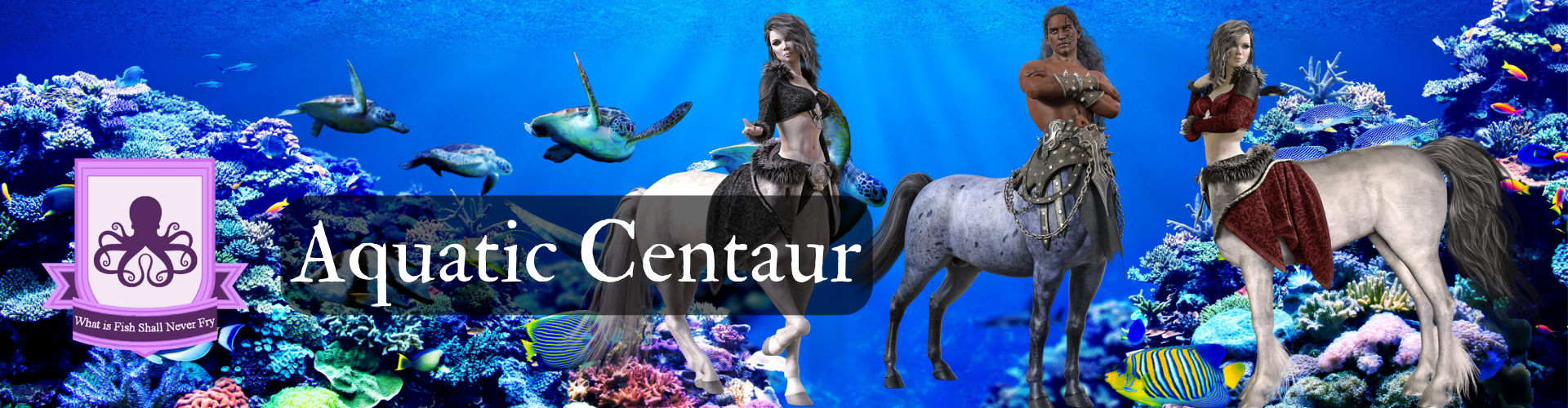
Aquatic Centaurs possess a unique fusion of humanoid and equine features. They have a human torso that merges seamlessly with an equine body. Their lower bodies are adapted for underwater life which include streamlined hooves and a powerful, undulating tail.
Biological Traits
Aquatic Affinity: Possess a natural connection to water magic such as manipulating water currents, create and/or calm tsunamis.
Enhanced Stamina: Well-adapted for prolonged underwater activity, showcasing remarkable stamina.
Scurry Communication: Learned at an early age. It's unknown if they learned from House Mollusca or the other way around.
Amphibious Skin/Lungs: When in water, their skin absorbs oxygen from the water. Have lungs for breathing on land.
Enhanced Stamina: Well-adapted for prolonged underwater activity, showcasing remarkable stamina.
Scurry Communication: Learned at an early age. It's unknown if they learned from House Mollusca or the other way around.
Amphibious Skin/Lungs: When in water, their skin absorbs oxygen from the water. Have lungs for breathing on land.
Genetics and Reproduction
Aquatic Centaurs reproduce through live birth. The gestation period is approximately 12 months, and offspring are cared for within close-knit family units. Genetic diversity is maintained through careful mate selection to ensure the preservation of beneficial traits. Aquatic Centaurs have 1 to 3 offspring in their lifetime due to their longevity and resource limitations.
Growth Rate & Stages
Aquatic Centaurs experience rapid growth during their early years, reaching maturity by the age of 20. They undergo stages similar to humans, progressing from infancy to adolescence to adulthood. The aging process slows down, and they exhibit remarkable longevity.
Ecology and Habitats
They inhabit underwater cities and communities built in intricate coral formations. These cities are designed to withstand ocean currents and provide shelter. Aquatic Centaurs are adept at navigating both open ocean and confined spaces within their coral homes. They migrate several times a year between their cities.
Biological Cycle
Their biology is influenced by lunar cycles, affecting reproductive behaviors and, in their belief, certain magical abilities. Full moons are considered auspicious, enhancing their magical prowess and strengthening the communal bonds.
Behaviour
Communal harmony is essential in their society, and cooperation is ingrained in their psychology. They are known for their empathy and strong familial bonds. The loss of a family member is deeply felt and influences an individual's behavior.
Additional Information
Facial characteristics
Aquatic Centaurs have humanoid facial features with expressive eyes. Facial markings and patterns are unique to each individual.
Average Intelligence
Highly intelligent, with a natural aptitude for magical arts and a deep understanding of their underwater environment.
Perception and Sensory Capabilities
Aquatic Centaurs have heightened senses adapted to underwater life. They perceive subtle changes in water currents, detect vibrations, and have exceptional low-light vision. While they are adapted to life under the seas, they can also breathe air and spend time on land.
Civilization and Culture
Beauty Ideals
Adornments such as enchanted seashell jewelry and intricate tattoos are considered beautiful. Graceful swimming and magical proficiency are admired traits.
Average Technological Level
Advanced in underwater architecture, magical arts, and the use of enchanted coral for crafting. Limited exploration of surface technologies.
Major Language Groups and Dialects
Abyssal Centaurian is the primary language, with regional dialects reflecting cultural nuances.
Common Etiquette Rules
Respect for elders, communal cooperation, and adherence to magical traditions are fundamental etiquette norms.
History
Rooted in ancient underwater civilizations, the history of aquatic centaurs is marked by a continuous struggle against magical threats. Their cities have weathered the ages, witnessing the rise and fall of powerful mages and the forging of alliances with other underwater races.
Historical Figures
Legendary mages who united the aquatic centaur clans against ancient adversaries are celebrated. Names like Tidemaster Selene and Coral Sage Maris echo through history.
Common Myths and Legends
Myths often revolve around powerful underwater entities, legendary mages, and tales of unity against supernatural threats.
Interspecies Relations and Assumptions
Maintain alliances with other underwater races. Relations with land-dwelling races were limited to Native Alaskan (such as the Aleuts, Yupik, Inupiaq, Haida, and Tlingit), the First Nations of the Pacific Northwest, and the Indigenous peoples of Siberia. Their oral histories means not much got written down about the Aquatic Centuars and with the spread of Colonalism, they withdrew from the surface for the most part.
WIP
Streamer
Missing
Status: Location Unknown
Deceased
Status: Deceased Character
Retired
Status: Retired Character or Article


Navigation
Lifespan
1,500 years
Average Height
Average human upper body height ranges from 5'1" to 5'7", with the horse body adding an additional 4 to 5 feet.
Average Weight
Ranges from 700 to 900 lbs, with variations based on individual diet and lifestyle.
Average Physique
Athletic and well-muscled, adapted for both land and underwater mobility.
Body Tint, Colouring and Marking
Skin coloration varies from pale blues to deep oceanic hues. Horse fur exhibits a mix of white, blues, and purples, with intricate patterns often reflecting family or regional affiliations.
Related Myths



Comments