





Were Bites: A Language of Love, Friendship, and Teeth
So, what's the deal with the biting thing?
Scene: Nova and Happy hanging out with their friend Imogen in the Windy Willows "The Den" while Shy listens in on the conversation
Imogen: So how do you know if the bite is like, a friendly bite or an angry bite?
Happy : chewing on Nova's arm Mrph mrey phreeming?
Imogen: What?
Nova: She said, are they bleeding?
Imogen: That can’t be the only thing.
Happy: spits out the arm Well, there are lots of different kinds of werebeasts. Most of us have different instincts.
Nova: Like I'm a little more likely to scratch than bite sometimes.
Happy: And sometimes I want to chew on people I like as much as I want to chew on people I don’t like. The difference is intent.
Imogen: How do you tell them apart?
Nova: Well, you might just have to guess and hope the odds are in your favor.
Alternate Image Text:
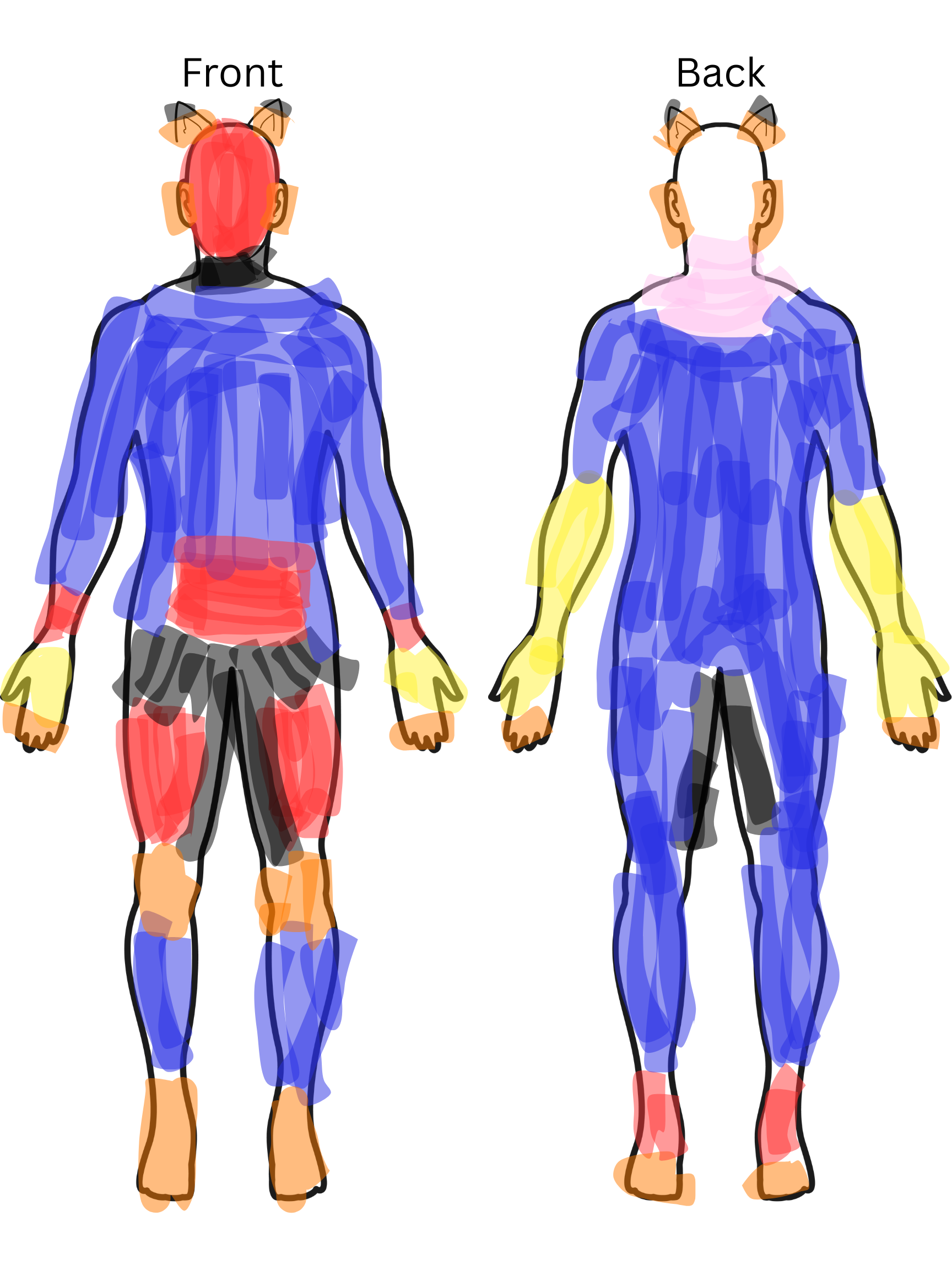
Happy pulls a projector screen out of… somewhere, and then projects onto it from… somewhere else. The whole setup is a little confusing, but when an outline of a human body pops up onto the screen, it starts to make a little more sense. Different parts of the body are shaded with different colors.
“Take this with a grain of salt,” she says, tapping at the diagram with a pointer that she definitely wasn’t holding a minute ago, “because it’s mostly from my perspective as a werecoyote. You might find different answers from different kinds of feline or canine werebeasts. And some individual werebeasts are more closely tied to their animal instincts than others, so these aren't hard and fast rules. But I like statistics and research, so I made this diagram explaining in very general terms the difference between a good bite and a bad bite from your were friends.”
The Zones
The Pink Zone: “You Are Baby”
Many different animals in the wild carry their young in their mouths. When small enough, this is accomplished by wrapping their jaws around the entire baby. When larger, this is done by carrying them by the scruff at the back of their neck. This doesn’t exactly work for full sized humans, but when dealing with other werebeasts or animals, the “baby” instinct can kick in. If a werecanine or a werefeline tries to pick you up in their mouth by the back of your neck, congratulations! You’ve just been adopted by that person. Please do not attempt to resist.
The Blue Zone: “Roughhousing”
When you’re friends with a werebeast, a lot of their bites may be just playful. Gently tugging on someone’s arm, chewing affectionately on someone’s shoulder, nibbling at their shins, or headbutting someone in the side can all be examples of play. When you don’t have opposable thumbs, sometimes you gotta make do with what you have, and what werebeast usually have is teeth.
Hot tip: if a canine werebeast is sneezing while biting you, this is a pretty good indication that they are playing instead of actually trying to hurt you. It’s a trait shared with domestic dogs to show each other that they are not trying to hurt each other.
The Yellow Zone: “I’m Overstimmed And Done Playing; Stop Touching Me”
This is the “spin and snap” warning bite. It’s mostly used when a werebeast gets very over-stimulated or goes non-verbal for any reason, to indicate that they want to be left alone and aren’t messing around. A nip in any of these areas might draw a thin scratch of blood, but it won’t cause any lasting damage. And just because your were friend bites you like this doesn’t mean your friendship is at risk. Come back to them once they’ve calmed down a bit and all will be forgiven! These kind of bites are mostly to get the other person’s attention and warn them to back off… or else.
The Orange Zone: “I’m Mad At You”
A bite to anywhere in the Orange Zone is more about inflicting pain than actual injury. These are mostly used when a werebeast wants to send a harsh message without causing any kind of permanent damage. Fingers, ears, and knees are all sensitive areas where the bone is right underneath the skin, and it doesn’t take much pressure to cause pain. A bite to the ear could also cause minimal aesthetic damage without affecting the function of the ear. This is only very rarely used against friends, and only when the werebeast is very angry. It’s usually reserved for spats between rivals or for friendships that have ended in betrayal.
The Red Zone: “We In A Fight B*tch”
If you’re in an altercation with a werebeast who is actually trying to hurt you, these are the areas they’ll probably go for. These aren’t instant kill zones, but they are sensitive parts of the body that will hurt a lot if you get bitten there. Injuries in some of these places could lead to permanent and perhaps eventually lethal damage, depending on how quickly you can get access to medical attention.
Show SpoilerPrincess ShyRedFox: Looking rather embaressed I'm almost afraid to ask what the last color means.
Imogen: I'm not! Happy, what does the black mean?
Happy: cracks knuckles and grins
Nova: starts giggling uncontrollably
The Black Zone: “I'm Taking Control Of Your Bloodline… One Way Or Another”
There are a few places on the body where your friendly neighborhood werebeast won’t bite unless they mean Business with a capital B. “Go for the Throat” is not just a euphemism when you have a set of fangs.
Show SpoilerThere’s only one exception to this, and that’s if you and your were partner like to explore some… spicier elements to your romance.
Yes, I’m talking about sex. Look, you and your partner(s) can have as much wild and kinky power play as your little hearts desire. I promise I won’t judge. I mean, look at me. Happy gestures vaguely around her.
Happy: freezes What?
Imogen: You said black was for… lethal areas. Why the tips of the ears specifically? It’s not like you’re in danger of killing someone from a bite to the ear.
Happy: …
Happy: ……
Happy: ………
Happy: They’re just really sensitive okay?
WIP
Streamer
Missing
Deceased
Retired



This information is relavent to some Werebeast species, but not all. In fact, it seems to be mostly a House Ailurus phenominom. As this research was primarily done by Werecoyote HappyHappySad, some of it is skewed by the "canine perspective", as they call it. To help provide balance to the research, Nova Firan was asked to help contribute some observations.
Yeah, bunnies bite too... If it's a gentle pinch that doesn't break the skin, it's affection, especially if we lick you during or after and our bodies and ears are relaxed. If we draw blood, though, especially if we growl, lunge, or do the kitty-puff-fur thing, that's trouble. Great presentation, Happy!


Comments