




Keno City
Keno City is a small silver mining community in Yukon, Lapin Protectorate, at the end of the Silver Trail highway, which connects to the Klondike Highway at Stewart Crossing. Waxing and waning fortunes over the years as a result of mine closures and re-openings have led to local self-reliance, and distrust of corporations and governments. The majority of Keno City's current population identify as Restorationists.
Government
Since 2020, Keno runs itself through the "Keno Council," which deals collectively with territorial and federal government authorities and other outside entities. This has given them more political weight in such negotiations, but makes it difficult to organize quickly on larger issues.
Infrastructure
Highway access is maintained by the Lapin government, but local roads are maintained by the hamlet. Most access to outlying settlements is via hard-packed dirt rural roads. Power is provided by the Yukon Territorial government, and is well maintained, but is still prone to occasional failure due to winter storms. Most residents, if they are hooked up to the power grid at all, maintain generators and solar panels. Internet and broadcast TV are mostly available through satellite reception, which is also true of phone access outside the hamlet's town limits. Sewer needs are dealt with primarily through septic tanks or outhouses.
History
Keno City was named after the gambling game Keno, which was popular in mining camps at the turn of the 20th century. It is 13 kilometres away from Elsa, Yukon, which was once a privately-owned mining town. Rich silver and lead ore deposits were found on Keno Hill in 1919, and since then the population of the community has fluctuated in response to the mining activity in the area. When United Keno Hill closed the mines in 1989, literally overnight, the people in the Keno area successfully marketed Keno City as a quiet, tranquil community, seeking to keep their community alive through tourism.
With the property abandoned by the previous owners, and mounting environmental impacts due to metal laden water coming from mine adits, in 2006 the Canadian Federal Government sold the assets of former United Keno Hill Mines through the Supreme Court to a Canadian mining company subsidiary for $410,000. Alexco now became the owner of the Yukon Keno Hill Silver district (23,350 hectares with 35 previously producing mines, its own private town of Elsa, and the infrastructure), under the condition that they stop the environmental degradation and clean up past impacts. With this deal Alexco also became the sole-source contractor to the Government of Canada in charge of cleaning up the environmental mess left by former mining activities.
In 2009 Alexco decided to resume silver mining in the district. The then-15 residents of Keno City opposed Alexco's proposal to build the crusher/mill and tailing facility less than one km from their residential homes, but their protests fell on deaf ears. Yukon's Department of Energy, Mines and Resources issued Alexco a license to proceed to mine the area in November 2009. While Keno continued to oppose the mill location, there was support for the project in the local community of Mayo and the First Nation of Nacho Nyak Dun, both of whom live 60 km away from the mill plant. Test runs of just the ball mill showed noise levels of 50-55 dbA.
So much for our tourism industry.Then in 2020 came the reawakening of The Iron Tome, a zombie apocalypse, and the complete collapse of the Canadian government. This time, more than just local industry fell apart. Key supplies failed to make it to the remote community as infrastructure failed on an apocalyptic scale. Fuel ran out, leaving the Kenos, along with the locals in Mayo and the Nacho Nyak Dun First Nation, reliant on animals for transportation and wood fire for heat. A local dairy farmer slaughtered their entire herd over the course of the winter, which was the only thing, along with subsistence hunting, that prevented starvation. As if all of that hadn't been bad enough, Keno saw its share of Zombies in The First Word War, since one of the bases of operations established by the first modern Night Monarch, The Nite Qing, was in Stewart. By the time House Chiroptera finally made contact with Keno, Mayo, and Nacho Nyak Dun in mid-2021, the residents were deeply relieved to have access to essential trade once again, but were absolutely done with governments and outsiders, who had, in their minds, completely failed them. They also had no desire whatsoever to engage with any more "magical bullshit." And good feelings were in no way helped by the transfer of power to the Lapin Protectorate when Queen TaraFaeBelle assumed the Chiropteran House Leadership and moved their seat to Australia in 2022; nor by the Lapin government taking over, and reopening, the silver mine in 2023 to support the building of the Stuart Lake Power Plant. While there has been a relative "population boom" in the hamlet, swelling their numbers from 15 to 87, in part due to employees of the mine moving in, and in part due to people banding together against common threats, most of the population would rather the rest of the world just sell them food and gas and then go away. Especially the "damn witches," whom they see as being to blame for the worst, and most recent, chaos.
I'm just sick and tired of these arrogant rich bastards just coming in and doing whatever the hell they want, only to leave us high 'n dry again. They can piss right off!
Tourism
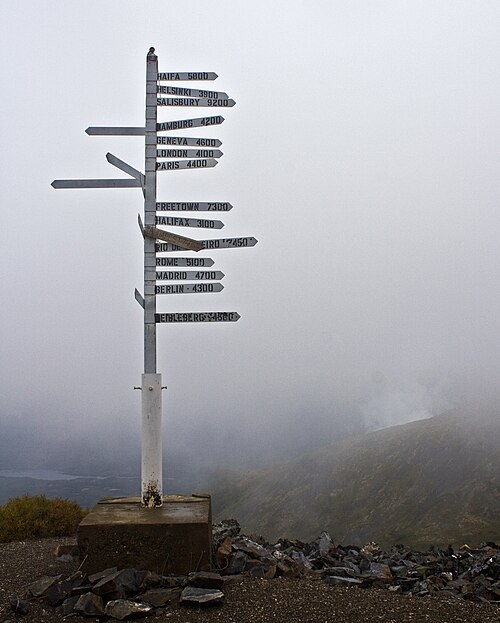
Keno City has developed some tourism-based businesses. Its main attraction is the Keno Mining Museum, which covers mining in Yukon from the early 1900s until the present. The signpost on the top of Keno Hill shows distances to places around the world. However, their nascent tourism industry continues to struggle, which was not helped by the mine reopening in 2009, nor the events of 2020.
The British Yukon Navigation Company sternwheeler SS Keno is preserved in Dawson City and protected as a National Historic Site.
Architecture
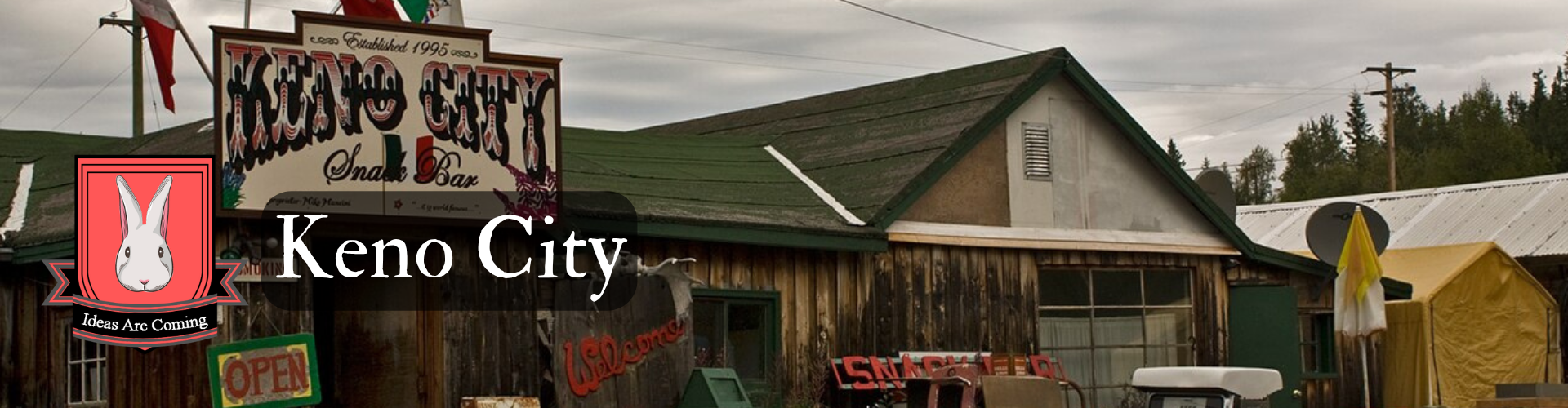
Building in Keno, as in much of the remote Lapinite North, tends to the practical as opposed to the beautiful. Since everything is so expensive to ship, materials are reused and recycled as much as possible. The harsh climate is also hard on Human structures, especially fabric and paint. Most wooden buildings either display open, weather-stained wood, or stripped and faded paintwork. Handmade and hand-painted signs are common because they are often easier to come by.
Geography
The North is known for its stunning, if sometimes stark, beauty. It is a spectacular landscape of mist, mountains, and the boreal forest, with amazing views almost everywhere one would think to look. Unique flora and fauna can be found throughout the landscape. It is not uncommon for moose to wander through town, and residents make sure to seal their garbage firmly against the bears.
Oh yeah, it's beautiful! Most of the North really is. Appeals to a wild heart, y'know? I have no idea what the Canadian government was thinking. We really gotta move that mill.
Climate
The average winter temperature in the Yukon is mild by Lapin arctic standards, but no other place in North America gets as cold as the Yukon during extreme cold snaps. The temperature has dropped down to −60 °C (−76 °F) three times, 1947, 1952, and 1968. The most extreme cold snap occurred in February 1947 when the abandoned town of Snag dropped down to −63.0 °C (−81.4 °F). Annual precipitation is mostly in the form of snowfall.
When I lived in Stewart, there was student parking at the elementary schools. That was for the skidoos. And there were signs on the top of the the power poles that read, "Please do not walk near power poles, power lines are buried."Unlike most of the Lapin Protectorate, where the most extreme heat waves occur in the late summer months, the Yukon's heat waves tend to occur in June and even May. The Yukon has recorded 36 °C (97 °F) three times, and many of these records were in the Keno area. The first time was in June 1969 when Mayo recorded a temperature of 36.1 °C (97 °F). The old record was broken 21 years later in June 2004 when the Mayo Road weather station, located just northwest of Whitehorse, the Yukon capitol, recorded a temperature of 36.5 °C (97.7 °F).
Natural Resources
Keno's mine is a valuable source of silver, lead, and zinc. It remains the area's primary natural resource.
WIP
Streamer
Missing
Status: Location Unknown
Deceased
Status: Deceased Character
Retired
Status: Retired Character or Article


Type
Hamlet
Population
87
Inhabitant Demonym
Kenos
Location under
Owner/Ruler
The irony is that most of their problems would go away if they'd just let me build them a Transcontinental Portal. But I don't blame them at all for their reluctance. They've had a hard row to hoe.



Comments